If you’re over 50 and trying to eat healthier, you’ve probably noticed how much attention protein gets these days. From protein shakes and breakfast cereals to nutrition advice online, it seems everyone has an opinion about how much protein we should be eating.
One question many of us ask is: How much protein do you need after 50? The answer depends on factors such as activity level, health, and individual nutrition needs.
But how much do we really need?
The answer isn’t quite as simple as choosing a number. Our protein needs can vary depending on our age, activity level, overall health, and personal goals.
As we get older, maintaining muscle strength becomes increasingly important. Protein plays an essential role in supporting our muscles, particularly when combined with regular strength training.
The good news is that getting enough protein doesn’t necessarily mean making drastic changes to your diet or relying on expensive supplements.
In this article, we’ll look at what the research tells us about protein needs after 50, explain how to estimate a suitable daily amount, and explore simple ways to make protein a practical part of everyday eating.
How Much Protein Do You Actually Need After 50?
If you’ve researched protein recommendations, you may have noticed that the numbers don’t always agree. One source might suggest a relatively modest amount, while another recommends considerably more.
There’s a reason for that. Different recommendations are designed to address different nutritional needs and health goals.
The Standard Recommendation
The Recommended Dietary Allowance (RDA) for healthy adults is 0.8 grams of protein per kilogram of body weight each day.
This amount is intended to meet the basic protein needs of nearly all healthy adults. However, it isn’t specifically designed to maximize muscle growth or strength. [1]
Wondering which foods can help you reach your daily protein goal? Take a look at our article, “15 High-Protein Foods That Give You More Protein for Fewer Calories,” for practical food choices.
Recommendations for Older Adults
As we age, maintaining muscle becomes increasingly important. Some experts recommend higher protein intake for older adults, particularly those who are physically active.
One example is the PROT-AGE Study Group, an international team of 13 specialists in aging, medicine, nutrition, and exercise. The group was established through the European Union Geriatric Medicine Society in cooperation with other scientific organizations to examine protein needs as people age.
In a 2013 position paper, the group recommended approximately 1.0–1.2 grams of protein per kilogram of body weight daily for adults over 65, with higher amounts potentially appropriate for physically active individuals.
These are expert recommendations based on a review of scientific evidence, rather than a requirement that applies to everyone over 50. [2]
The 2025–2030 Dietary Guidelines for Americans also describe a higher general protein goal of 1.2–1.6 grams per kilogram of body weight per day. This guidance serves a different purpose from the standard RDA and the PROT-AGE recommendations. [3]
What Does This Mean for You?
The important thing to understand is that turning 50 doesn’t suddenly create one specific protein requirement for everyone.
Your activity level, overall health, dietary needs, and fitness goals all help determine an appropriate amount.
If you’re working to maintain muscle, become stronger, or improve your eating habits, understanding these recommendations is a useful starting point.
Rather than automatically choosing the highest number, focus on finding a protein target that makes sense for your individual circumstances.
How to Calculate Your Daily Protein Needs
Now that we’ve looked at the recommendations, let’s put those numbers into perspective.
You don’t need to be a nutrition expert to calculate an estimated daily protein target. All you need is your body weight and a little simple math.
Step 1: Convert Your Weight Into Kilograms
Most of us in the United States measure our weight in pounds, but protein recommendations are generally expressed in grams per kilogram of body weight.
To convert pounds into kilograms, divide your weight by 2.2.
For example, someone weighing 165 pounds would calculate:
165 ÷ 2.2 = approximately 75 kilograms.
Step 2: Compare the Protein Recommendations
Using our 165-pound example, here’s how different protein intake levels translate into daily amounts.
| Protein Intake | Approximate daily protein |
| 0.8 g/kg | 60 grams |
| 1.0 g/kg | 75 grams |
| 1.2 g/kg | 90 grams |
| 1.6 g/kg | 120 grams |
Notice that the numbers vary considerably. That’s why understanding the purpose of each recommendation is important.
These figures illustrate the calculation; they aren’t personalized prescriptions.
Step 3: Choose a Target That Fits Your Circumstances
Someone who is physically active and working to build muscle may have different nutritional needs than someone who is less active.
Your health history, activity level, and overall diet should help guide your decision.
People with certain medical conditions, particularly chronic kidney disease, may have different protein requirements. Some may need to limit their intake, while others may need more protein depending on their treatment. If you have kidney disease or another condition affecting your nutritional needs, work with your healthcare professional or registered dietitian to determine an appropriate target. [4]
People with substantial excess body weight, fluid retention, or recent major weight changes may also need guidance about which weight to use in the calculation.
Step 4: Compare Your Target With What You Already Eat
Before making major changes, take a few days to record how much protein you normally consume.
Read nutrition labels, pay attention to serving sizes, and add up the protein in your meals and snacks.
You may discover that you’re already close to an appropriate target. Or you might find that adding a protein-rich food to one meal makes a meaningful difference.
The goal isn’t to chase the highest possible number. It’s to develop an eating pattern that supports your health, activity, and personal goals.
Meeting Your Protein Goal Without Overcomplicating Your Diet
Knowing how much protein you need is one thing. Figuring out how to get that protein into your daily meals is another.
The good news is that reaching your protein goal doesn’t necessarily require a complete change in the way you eat. Often, a few thoughtful adjustments can make a meaningful difference.
Spread Your Protein Throughout the Day
Suppose you’ve determined that 90 grams of protein per day is an appropriate target.
Rather than trying to get most of that protein in one large meal, you could divide it among your regular meals.
| Meal | Protein |
| Breakfast | 25 grams |
| Lunch | 30 grams |
| Dinner | 25 grams |
| Snack | 10 grams |
| Daily total | 90 grams |
This isn’t a required eating schedule. It’s simply one way to make a daily goal easier to manage.
Choose Foods That Give You More Protein for Their Calories
If you’re trying to maintain or lose body fat while supporting muscle strength, it helps to pay attention to both protein and calories.
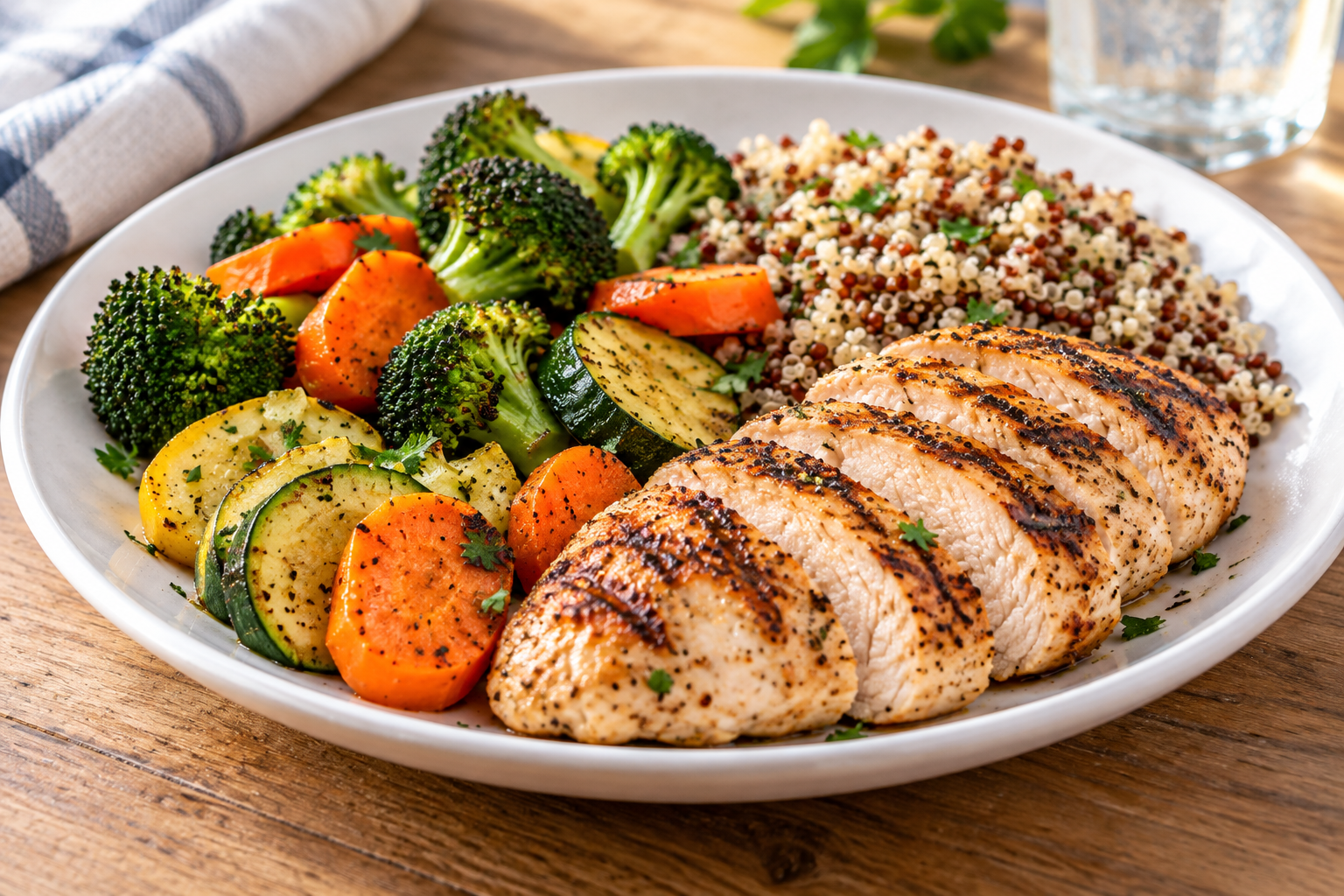
Some foods provide substantial protein without adding a large number of calories. Examples include:
- Plain nonfat Greek yogurt
- Skinless chicken breast
- Fish and seafood
- Egg whites
- Low-fat cottage cheese
- Tofu and other soy foods
Other nutritious foods, such as nuts and seeds, also provide protein but contain more calories per serving.
That doesn’t make them poor choices. It simply means portion sizes matter when you’re working within a calorie budget.
Look for Easy Opportunities to Add Protein
You don’t necessarily need to overhaul your meals to increase your protein intake.
You might add Greek yogurt to breakfast, include a serving of beans with lunch, or choose a protein-rich snack between meals.
Protein shakes can also be convenient when you’re short on time or have difficulty meeting your needs through regular meals.
Protein breakfast bars are another convenient option, particularly on busy mornings. However, not all bars offer the same nutritional value. Compare the amount of protein with the total calories, added sugar, and saturated fat before choosing one.
Remember that convenience foods are tools, not requirements. Whole foods can provide protein along with other important nutrients, including fiber, vitamins, and minerals.
Is More Protein Always Better?
It’s tempting to assume that if some protein is good, more must be better.
But research suggests that the relationship between protein intake and muscle development is more complicated.
A 2018 systematic review and meta-analysis by Morton and colleagues examined protein supplementation alongside resistance training. The researchers found that additional gains in fat-free mass tended to level off at an average total protein intake of approximately 1.6 grams per kilogram of body weight per day. [5]
That finding does not establish a universal upper limit or mean that everyone needs 1.6 g/kg daily. Individual needs vary, and the study focused on people participating in resistance training.
Protein is important, but it works alongside regular physical activity, adequate nutrition, and recovery. Eating more protein by itself doesn’t guarantee additional muscle growth.
Bringing It All Together: Small Changes, Lasting Results
Getting enough protein after 50 doesn’t have to be complicated. Start by understanding the recommendations, estimating a target that fits your circumstances, and taking a closer look at what you already eat.
From there, focus on manageable improvements. Adding protein to breakfast, choosing satisfying meals, and including strength-building activities in your routine can all contribute to a healthier lifestyle.
The Centers for Disease Control and Prevention recommends that adults include muscle-strengthening activities on at least two days each week, along with regular aerobic activity. [6]
Remember, the goal isn’t perfection. It’s consistency. Small changes that you can maintain are often more valuable than dramatic changes that only last a few weeks.
We’re not changing how we eat for the next 30 days. We’re changing how we live for the rest of our days.
That’s what the Fit After 50 Journey is all about.
References
[1] American Heart Association. Protein and Heart Health.
https://www.heart.org/en/healthy-living/healthy-eating/eat-smart/nutrition-basics/protein-and-heart-health
[2] Bauer, J., et al. (2013). Evidence-Based Recommendations for Optimal Dietary Protein Intake in Older People: A Position Paper From the PROT-AGE Study Group.
https://pubmed.ncbi.nlm.nih.gov/23867520/
[3] Dietary Guidelines for Americans, 2025–2030.
https://cdn.realfood.gov/DGA.pdf
[4] National Institute of Diabetes and Digestive and Kidney Diseases. Healthy Eating for Adults With Chronic Kidney Disease.
https://www.niddk.nih.gov/health-information/kidney-disease/chronic-kidney-disease-ckd/healthy-eating-adults-chronic-kidney-disease
[5] Morton, R. W., et al. (2018). A Systematic Review, Meta-Analysis and Meta-Regression of the Effect of Protein Supplementation on Resistance Training-Induced Gains in Muscle Mass and Strength in Healthy Adults.
https://pubmed.ncbi.nlm.nih.gov/28698222/
[6] Centers for Disease Control and Prevention. Adult Activity: An Overview.
https://www.cdc.gov/physical-activity-basics/guidelines/adults.html