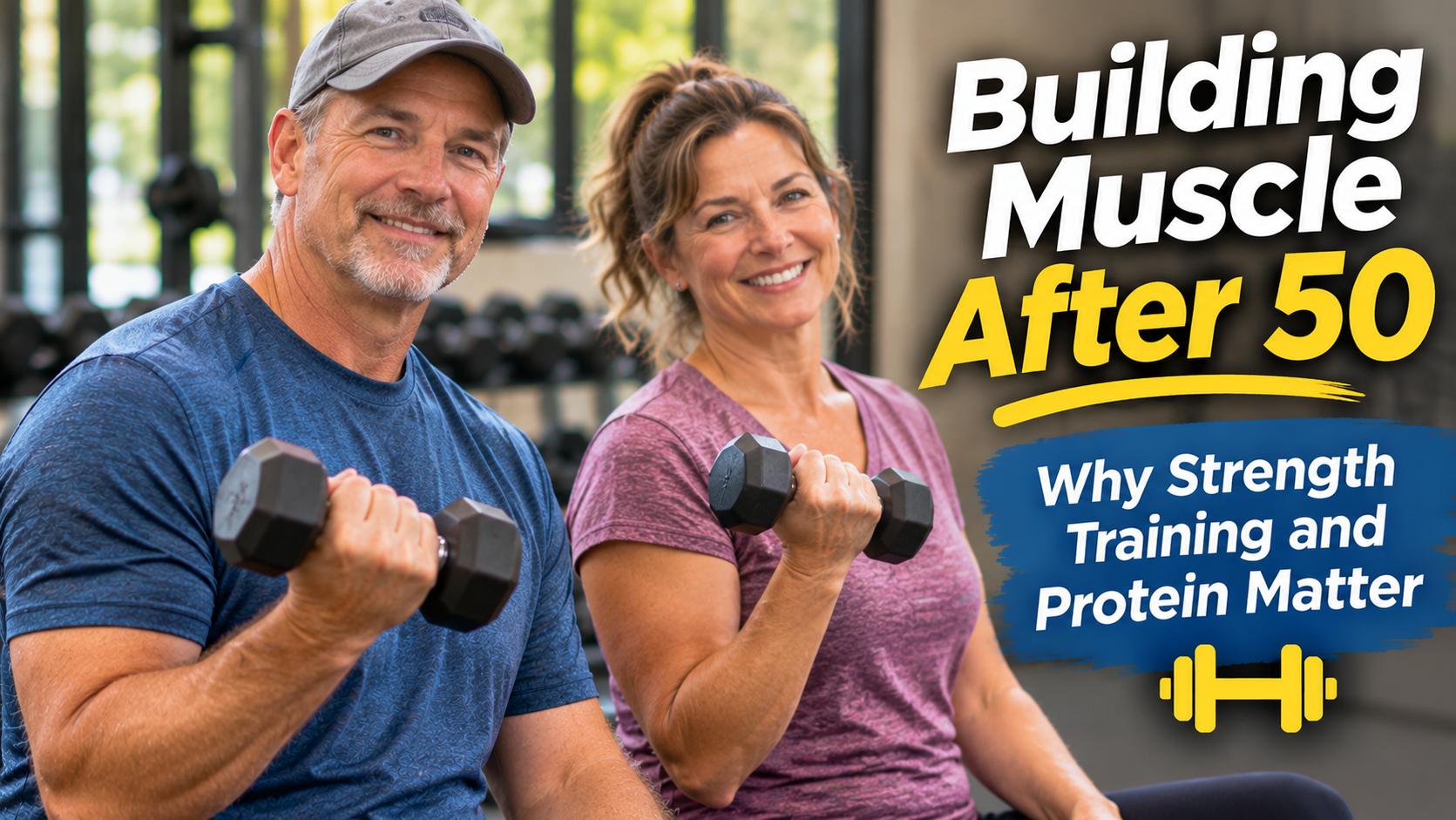
Building muscle after 50 is about more than appearance. It’s about developing the strength to enjoy everyday life.
Carrying groceries, climbing stairs, getting up from the floor, or simply keeping up with everyday activities all require muscle strength.
As we get older, maintaining that strength becomes increasingly important. And for those of us who would also like to develop a more muscular, toned appearance, there’s encouraging news: being over 50 doesn’t mean we’ve missed our opportunity to build muscle.
I’m working toward that goal myself.
For me, building strength is about more than looking better. It’s about becoming healthier, staying active, and preparing my body for the years ahead.
Two important pieces of that journey are strength training and proper nutrition, particularly getting enough protein.
Let’s look at how they work together and how we can put that knowledge into practice.
Can You Really Build Muscle After 50?
Yes. Our muscles can continue responding to resistance training as we age.
A Cochrane review examining 121 studies involving approximately 6,700 older adults found that progressive resistance training improved muscle strength and certain measures of physical function. [1]
That doesn’t mean everyone will achieve the same results or develop muscle at the same rate. Age, health, training experience, nutrition, and consistency all play a role.
But it does mean that getting older isn’t a reason to give up on becoming stronger.
And that’s encouraging for those of us who are just getting started.
Getting Started With Strength Training
You don’t need to become a bodybuilder or spend every day at the gym to begin improving your strength.
According to the Centers for Disease Control and Prevention (CDC), adults should participate in muscle-strengthening activities at least two days per week, working all major muscle groups. [2]
There are several ways to accomplish this, including:
- Bodyweight exercises: Push-ups, squats, and modified movements that use your own weight for resistance.
- Resistance bands: Portable equipment that provides resistance throughout an exercise.
- Dumbbells: Free weights that can be used for many upper- and lower-body movements.
- Kettlebells: Weights that can be incorporated into strength exercises when used with proper technique.
- Weight machines: Gym equipment that can help guide certain movements.
The best starting point is one that matches your abilities and that you can follow consistently.
What My Wife and I Are Doing
My wife and I have started exercising together two to three times a week using an app called Lift Beyond Limits.
We’re fortunate to have access to a gym, so we’re following the exercises the app recommends for that setting.
So far, our workouts have included resistance bands, dumbbells, kettlebells, and bodyweight exercises.
We’re still early in the process, and I haven’t started any additional workout programs yet.
Right now, our focus is on establishing a routine, learning the exercises, and gradually improving our strength.
One thing I especially appreciate is that we’re doing this together. Having someone alongside you can make working toward a healthier lifestyle a shared experience.
I’m not presenting myself as a fitness expert. I’m someone over 50 who is putting these ideas into practice and learning along the way.
Building Strength One Step at a Time
One important principle of strength training is progressive resistance.
In simple terms, it means gradually making an exercise more challenging as your strength improves.
For example, someone starting with wall push-ups might eventually progress to counter push-ups and then more challenging variations.
Someone exercising with dumbbells might begin with a manageable weight and gradually increase repetitions or resistance as the exercise becomes easier.
The important word here is gradually.
You don’t have to lift the heaviest weight or push yourself to exhaustion to make a workout worthwhile.
Good technique, appropriate resistance, and steady progression are more useful goals than trying to prove how much you can lift.
Keeping a simple record of your exercises, repetitions, and resistance can help you recognize improvement over time.
A Personal Note About Heart Health
Heart health is something I take seriously.
I’ve been living with cardiomyopathy for several years. With treatment and medication, my heart function has returned to normal, and I’ve been cleared to participate in physical activity. That improvement occurred while receiving medical treatment, before I began my current exercise routine.
Living with this condition has made me more aware of the importance of taking care of my health. Building strength is now part of my effort to stay healthy, remain physically capable, and enjoy an active life as I get older.
But everyone’s medical situation is different.
If you have a heart condition, another significant medical concern, or restrictions on physical activity, speak with your healthcare professional about what exercise is appropriate for you.
During exercise, stop if you experience concerning symptoms such as dizziness, unusual breathlessness, or chest discomfort. Chest pain or other possible emergency symptoms require immediate medical attention.
Being stronger is a worthwhile goal, but exercising safely matters just as much.
Why Protein Matters When Building Muscle
Strength training challenges our muscles. Protein provides amino acids that our bodies use to maintain and repair muscle tissue.
Both play important roles in developing strength and supporting muscle growth.
A 2018 systematic review and meta-analysis found that protein supplementation provided additional average benefits for muscle mass and strength during resistance training in healthy adults. [3]
That doesn’t mean everyone needs protein powder.
It means adequate protein intake can help support the work we’re doing through exercise.
For practical information about protein needs, see our companion article:
How Much Protein Do You Really Need After 50?
Protein requirements vary with factors such as body size, activity level, and health. People with certain medical conditions, including kidney disease, may need individualized guidance.
How I’m Managing My Nutrition
Along with strength training, I’m paying close attention to what I eat.
I’m working with a nutritionist from Mindful Movement & Nutrition to help guide my nutrition goals.
I use an app called Everfit to track both my daily calorie intake and protein consumption. My nutritionist monitors my entries through the app, helping me stay focused on my goals.
One of the challenges I’ve encountered is finding the right balance between getting enough protein and keeping my calories under control.
I’m working toward building muscle while reducing excess body fat, and I’m learning that nutrition and exercise need to work together.
For me, this isn’t about following a temporary diet. It’s about developing eating habits I can maintain for years to come.
Choosing Protein-Rich Foods
Protein can come from many everyday foods.
Some examples include eggs, chicken, fish, lean meats, beans, tofu, milk, and other protein-rich foods.
Personally, I pay attention to both protein and calories because I’m working toward improving my body composition.
I also use protein shakes when I need a convenient way to help meet my daily protein goal.
But protein supplements aren’t a requirement for building strength. Regular foods can provide the protein many people need.
For more practical food choices, take a look at:
15 High-Protein Foods That Give You More Protein for Fewer Calories
The goal isn’t to eat as much protein as possible. It’s to get an appropriate amount while maintaining a balanced, nutritious diet.
Don’t Forget Recovery
Building strength involves more than the time spent exercising.
Your body also needs opportunities to recover.
For beginners, scheduling challenging strength-training sessions on nonconsecutive days can be a manageable approach.
Adequate food, sleep, and recovery time all contribute to a sustainable routine.
If you’re also trying to lose excess body fat, be careful about continually reducing calories while increasing exercise. A registered dietitian can help you balance energy intake with your training goals.
Consistency matters, but so does giving yourself enough time to recover.
Strength Training Is Only Part of the Picture
Strength training is important, but it shouldn’t replace other types of physical activity.
The CDC recommends that adults aim for at least 150 minutes of moderate-intensity aerobic activity each week, along with muscle-strengthening exercise. [2]
Walking, cycling, swimming, and other activities can contribute to aerobic fitness.
For adults 65 and older, CDC guidance also emphasizes activities that improve balance. [4]
The right combination depends on your abilities, interests, and health.
A balanced routine can help support overall fitness rather than focusing on muscle size alone.
Measuring Progress Beyond the Bathroom Scale
This is something I’ve been thinking about in my own fitness journey.
The number on the scale doesn’t tell the whole story.
Someone who is exercising regularly may notice improvements in strength or physical ability even when their body weight changes very little.
Consider tracking things such as:
- Completing more repetitions with good technique.
- Using slightly greater resistance.
- Progressing to a more challenging exercise.
- Finding everyday physical tasks easier.
- Becoming more consistent with workouts.
Changes in appearance may happen at a different pace from changes in performance.
For me, the bigger goal is to become stronger, reduce excess body fat, and develop a healthier, more muscular body.
I want to see what I can accomplish through consistent effort, without expecting overnight results.
Building Strength for the Years Ahead
Building muscle after 50 doesn’t have to begin with an elaborate workout plan.
It can begin with a couple of manageable training sessions each week, attention to nutrition, and a willingness to make gradual improvements.
Research gives us good reason to believe that strength training can benefit older adults. But the results depend on putting those principles into practice consistently and safely.
Getting Ready for My Next 50 Years
My wife and I are still at the beginning of our strength-training journey, and I’m looking forward to seeing where it takes us.
I’ve often said that I’m getting ready for my next 50 years. I know there’s no guarantee of another 50 years, but that doesn’t mean I shouldn’t prepare for them.
For me, building muscle after 50 isn’t just about looking stronger. It’s about being stronger, maintaining my independence, and having the physical ability to enjoy the things that matter to me.
I’m learning that lasting improvements don’t happen overnight. They come from making better choices, staying consistent, and building habits that become part of everyday life.
I’m not making these changes for the next 30 days or even the next year.
I’m getting ready for my next 50 years.
References
[1] Liu CJ, Latham NK. Progressive resistance strength training for improving physical function in older adults. Cochrane Database of Systematic Reviews. 2009;(3).
https://pubmed.ncbi.nlm.nih.gov/19588334
[2] Centers for Disease Control and Prevention. Adult Activity: An Overview.
https://www.cdc.gov/physical-activity-basics/guidelines/adults.html
[3] Morton RW, et al. A systematic review, meta-analysis and meta-regression of the effect of protein supplementation on resistance training-induced gains in muscle mass and strength in healthy adults. British Journal of Sports Medicine. 2018;52(6):376–384.
https://pubmed.ncbi.nlm.nih.gov/28698222
[4] Centers for Disease Control and Prevention. Older Adult Activity: An Overview.
https://www.cdc.gov/physical-activity-basics/guidelines/older-adults.html
Editorial note: This article shares personal experience and general educational information. It is not individualized medical or exercise advice. Lift Beyond Limits, Everfit, and Mindful Movement & Nutrition are mentioned because they are part of the author’s actual routine; no affiliate relationship is claimed.